
Financial markets have always revolved around one central idea: the exchange of value. In traditional stock trading, this value is simple: you buy a stock when you expect it to go up, and sell it when you believe it will fall. Your profit or loss is determined entirely by the movement in the stock’s price.
But as the market evolved, so did traders’ need for flexibility, risk control, and precision. Investors wanted a way to profit not just from direction, but from volatility, time, and probability. That’s how options trading was born, a world where creativity and structure merge, giving traders control over when, how, and why they profit.
And at the heart of this sophisticated system lies one key concept: the Strike Price.
The strike price is the foundation of every option contract. It determines whether a trade will end in profit, loss, or balance. It’s not just a number; it’s a strategic line that defines your potential and your exposure.
To understand how professionals make consistent money trading options, you must understand the strike price, not just what it means, but how it interacts with market price, volatility, and time.
1. Understanding the Basics: What Are Options?
Before we go into strike prices, we need to understand what an option really is.
An option is a financial contract that gives its holder the right, but not the obligation, to buy or sell an underlying asset, which may be a stock, ETF, index, future, currency, or commodity, at a specific price (the strike price) before or on a specific date (the expiration date).
There are two types of options:
- Call Options – give you the right to buy the stock.
- Put Options – give you the right to sell the stock.
Each option contract controls a fixed number of shares, usually 100 shares per contract in most U.S. markets. To acquire this right, traders pay a premium, a cost determined by factors such as volatility, time until expiration, and proximity to the current market price.
Think of it like a reservation: you pay a small fee to secure the right to buy or sell at a future date. You don’t have to exercise the right, but if the market moves in your favor, that reservation becomes valuable.
2. Introducing the Strike Price
The Strike Price (also called the Exercise Price) is the predetermined level at which the option holder can buy or sell the underlying asset.
- For a Call Option, the strike price is the price at which you can buy the asset.
- For a Put Option, the strike price is the price at which you can sell the asset.
It’s the benchmark that defines whether your option will make or lose money.
Example:
Suppose you buy a call option on Apple stock with:
- Strike Price: $180
- Expiration Date: 1 month from now
- Premium: $5 per share
This gives you the right to buy Apple at $180 at any time before expiration.
Now:
- If Apple rises to $190, your option is valuable; you can buy at $180 and sell at $190, making a profit.
- If Apple stays below $180, your option is worthless, and your only loss is the $5 premium.
So, the strike price anchors the entire deal; it tells you where your right becomes profitable.
3. The Relationship Between Strike Price and Market Price
Every option’s profitability depends on how its strike price compares to the market price of the underlying asset.
This relationship creates three classifications that traders must understand:
a) In The Money (ITM):
An option that would be profitable if exercised immediately.
- Call Option: Market price > Strike price
- Put Option: Market price < Strike price
Example: If Apple’s stock is $190 and your call’s strike is $180, you’re “in the money” because you can buy at $180 and sell at $190.
b) At The Money (ATM):
When the market price ≈ strike price.
There’s little to no intrinsic value, but maximum sensitivity to price movement.
Example: Apple stock = $180, call strike = $180.
c) Out of The Money (OTM):
An option that would be unprofitable if exercised right now.
- Call Option: Market price < Strike price
- Put Option: Market price > Strike price
Example: Apple stock = $170, call strike = $180 → “out of the money.”
These three states are fundamental because they determine an option’s value, cost, and probability of profit.
4. Intrinsic and Extrinsic Value Explained
An option’s price (known as the premium) has two parts:
- Intrinsic Value – The real, immediate value of the option if exercised right now.
- Extrinsic Value – The additional value based on time left and volatility.
Let’s look at a call option on a stock trading at $100:
| Option Strike | Market Price | Intrinsic Value | Extrinsic Value | Total Premium |
| $90 (ITM) | $100 | $10 | $2 | $12 |
| $100 (ATM) | $100 | $0 | $5 | $5 |
| $110 (OTM) | $100 | $0 | $2 | $2 |
Notice that ITM options are more expensive because they already hold real value (intrinsic). OTM options are cheaper but riskier, relying solely on time and volatility.
5. Visualizing the Strike Price Concept
Imagine a chart where:
- The x-axis represents the stock price.
- The y-axis represents the profit/loss of your option.
For a Call Option, the payoff curve:
- Stays below zero (the premium cost) until the stock price rises above the strike price.
- Then it climbs upward sharply; every $1 move above the strike adds $1 of profit per share.
For a Put Option, it’s the reverse:
- Profit increases as the market price drops below the strike.
This visual (often called a payoff diagram) helps traders understand how the strike price defines the breakeven and potential gains.
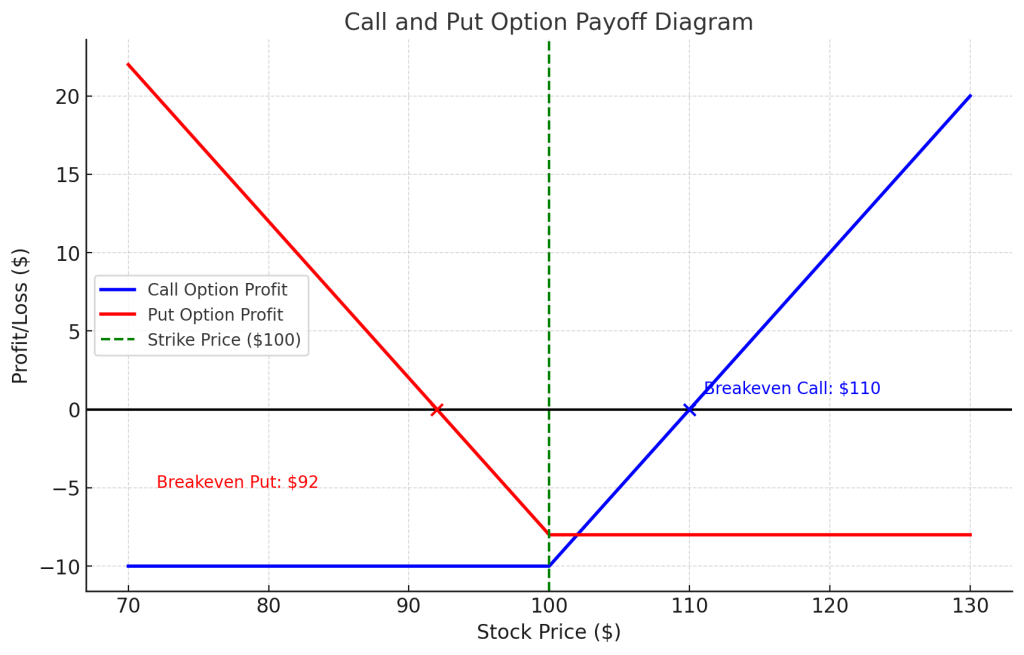
Example:
- Strike Price: $100 (green dashed line)
- Call Option Premium: $10
- Put Option Premium: $8
Key points:
- Call Profit (blue line): Starts below zero (premium paid) and rises above the strike price + premium ($110) — this is the breakeven.
- Put Profit (red line): Starts below zero, becomes profitable as the stock falls below $92 (strike price − premium), marking the put breakeven.
Here’s what happens at that point:
1. Call Option (Blue Line)
- If the underlying price is below $100, the call expires worthless. The loss = premium paid.
- Once the price exceeds $100, the option becomes in the money, and the payoff line rises upward as profit increases with every dollar above the strike.
- The intersection near the strike (where the call line crosses from negative to positive) represents the breakeven point, not exactly the strike.
- Breakeven = Strike + Premium paid
2. Put Option (Red Line)
- If the price is above $100, the put expires worthless. The loss = premium paid.
- When the price drops below $100, the option gains value — profit increases as the underlying price falls.
- The breakeven for the put is slightly below the strike, at
- Breakeven = Strike – Premium paid
Why Both Lines Cross the Strike Line
On the chart:
- Both lines touch or pivot around the strike price ($100), because that’s where the option transitions from out-of-the-money to in-the-money.
- However, they cross the zero profit line (breakeven) on different sides of the strike:
- The call crosses above zero at a price slightly above the strike.
- The put crosses above zero at a price slightly below the strike.
So, while visually both seem to “intersect near the strike,” they actually represent two different breakeven points relative to the same strike reference.
6. Why Strike Price Matters
The strike price determines:
- How much do you pay for the option (premium)
- How sensitive is your option to price movement
- Your probability of making a profit
- Your breakeven point
In short:
The strike price = the DNA of your trade.
A trader can buy the same stock with the same expiration, but choose different strikes, and still get completely different results.
7. Strike Price and Probability of Profit (Delta)
To measure how likely an option is to expire profitable, traders use a “Greek” called Delta (Δ).
Delta serves two purposes:
- It measures how much the option’s price changes when the underlying stock moves $1.
- It approximates the probability of expiring in the money.
For a call option:
- A Delta of 0.80 means the option has an ~80% chance of finishing ITM.
- A Delta of 0.20 means a 20% chance.
Typical Delta Ranges:
| Type | Call Delta | Put Delta | Description |
| ITM | 0.70 – 1.00 | -0.70 to -1.00 | Higher probability, more expensive |
| ATM | ~0.50 | ~-0.50 | Balanced risk/reward |
| OTM | 0.10 – 0.40 | -0.10 to -0.40 | Cheaper, speculative |
This is why professional traders often choose strikes based on Delta, balancing cost and probability of success.
8. Choosing the Right Strike Price
Selecting the right strike price isn’t random; it’s a strategic decision based on your:
- Market outlook (bullish, bearish, neutral)
- Risk tolerance
- Capital
- Time horizon
Let’s break this down:
If You’re Bullish:
- Aggressive approach: Buy OTM Calls (cheap, high leverage, lower success rate).
- Conservative approach: Buy ITM Calls (more expensive, but higher chance of profit).
If You’re Bearish:
- Aggressive: Buy OTM Puts.
- Conservative: Buy ITM Puts.
If You Expect Sideways Movement:
- Consider selling OTM options (like covered calls or cash-secured puts) to collect premium from time decay.
The strike price is your way of defining how much conviction you have in your trade idea.
9. Strike Price in Option Spreads and Strategies
Advanced traders use multiple strike prices to structure complex strategies that fit specific market views.
Example Strategies:
- Bull Call Spread
- Buy a call at a lower strike.
- Sell another call at a higher strike.
- Limits both profit and loss.
- Bear Put Spread
- Buy a put at a higher strike.
- Sell another at a lower strike.
- Profits from moderate downside.
- Iron Condor
- Combines four strike prices (two calls, two puts).
- Profits if the stock stays between two strike levels.
- Straddle
- Buy both a call and a put at the same strike price.
- Profits from a large movement in either direction.
Each strategy’s success depends heavily on where those strike prices are placed relative to the market.
10. Volatility and Its Effect on Strike Price Selection
Volatility is the extent to which a stock’s price fluctuates. When volatility is high:
- Option prices rise (since there’s a greater chance of large movement).
- OTM strikes become more valuable.
When volatility is low:
- Option prices fall.
- Traders may prefer ATM or ITM strikes for better directional exposure.
Volatility interacts with strike prices in complex ways; the same strike may cost more in a volatile market because the chances of it becoming profitable increase.
11. Strike Price, Time Decay, and Breakeven Points
Every option loses value as it approaches expiration; this is called Theta (time decay).
Your breakeven point depends on your strike and premium:
For Call Options:
Breakeven = Strike Price + Premium Paid
For Put Options:
Breakeven = Strike Price – Premium Paid
Example: If you buy a $100 call for $5, the stock must rise above $105 by expiration to profit.
This simple formula helps beginners avoid a common mistake, assuming any upward move guarantees profit. The strike and premium together set your real target.
12. Real-World Illustration: Multi-Strike Comparison
| Stock: XYZ Trading at $100 | Strike Price | Option Type | Premium ($) | Breakeven | Chance of Profit |
| 90 | Call | 11 | 101 | High | Conservative |
| 100 | Call | 5 | 105 | Moderate | Balanced |
| 110 | Call | 2 | 112 | Low | Aggressive |
Notice how lower strike prices cost more but offer a higher probability of profit, while higher strikes cost less but demand larger stock moves.

From Definition to Decision-Making
While the definition is straightforward, the real art of options trading lies in how these contracts interact with market structure and price behavior. Every successful trade begins not with prediction, but with understanding where the market is likely to react, where buyers step in, sellers fade, or volatility expands.
Beginners often focus only on direction: “Will the price go up or down?” But experienced traders focus on reaction zones: “Where is price likely to respond?”
This distinction separates speculation from strategy.
The Bridge Between Options and Market Structure
To trade options effectively, one must visualize how the market moves through zones of interest. These are areas where liquidity concentrates and institutional orders influence price direction. Recognizing these zones helps traders determine whether to position for a call or a put, and at what strike price the probability of profit is strongest.
That’s where structure-based analysis comes into play. Instead of relying solely on lagging signals or momentum indicators, structure-based tools help traders see where momentum builds or reverses before it’s visible to the crowd.
Practical Connection: The Golden Line Concept
This concept introduces Golden, Silver, and Bronze lines, visual markers that highlight key behavioral zones on a price chart. These zones are not predictions; they are data-driven regions where probability, liquidity, and trader psychology converge.
When viewed through the lens of options trading:
- These zones often align closely with optimal strike selection areas.
- A trader looking to buy call options may choose strikes just above a Golden Line support zone.
- A trader preparing for a put trade might target strikes near or below structural resistance.
By blending structural awareness with the mechanics of option pricing, traders can approach the market with clarity and intent rather than guesswork.
Understanding this helps newcomers connect theoretical knowledge (what an option is) with practical application (where to apply that knowledge). It turns abstract concepts into tangible, observable setups that can later guide more advanced learning, including how strike prices interact with volatility, delta, and time decay.
13. Common Mistakes Beginners Make with Strike Prices
- Choosing the wrong strike based on emotion: Don’t pick a round number (like $100) just because it “feels right.” Analyze volatility and probability.
- Ignoring breakeven: Always calculate the price the stock must reach to make a profit.
- Buying too far OTM options: Cheap options can be tempting, but often expire worthless.
- Not understanding time decay: The closer you are to expiration, the faster your option’s value erodes, especially OTM options.
14. Developing Strike Price Intuition
As you gain experience, strike selection becomes more intuitive. Traders begin to “see” opportunities, not as random strikes but as zones of probability.
Professionals often:
- Analyze implied volatility (IV) to gauge market expectations.
- Use Delta-based filters (e.g., “only buy calls with Delta above 0.60”).
- Model different strikes on payoff diagrams to visualize risk/reward.
- Compare option chain data to pick optimal strikes for the desired outcome.
Conclusion: Strike Price – The Centerpiece of Strategic Trading
In the vast landscape of financial markets, the strike price is the heartbeat of every option strategy, the point where potential transforms into opportunity. Whether analyzing time decay, volatility, or directional bias, all paths in option trading eventually circle back to one central question: Where does your strike sit?
Mastering this single concept gives traders the foundation to interpret market structure, define risk with precision, and approach every trade with intent instead of impulse. It’s not about predicting where the market will go, but preparing for how it behaves around the chosen strike, because strategy without structure is just speculation.
For traders committed to building this structure, OnePunch ALGO Academy serves as a refined ecosystem designed to strengthen understanding, execution, and consistency. Through guided education, live market analysis, and a collaborative learning environment, it helps traders align their decisions with data and discipline — two forces that define lasting success in trading.
Complementing this, the OnePunch ALGO YouTube Channel brings these lessons to life through real-market walkthroughs, visual breakdowns, and transparent discussions about the mental and technical dynamics behind each setup. It bridges theory and execution, turning concepts such as strike prices, delta shifts, and volatility reactions into actionable insights.
Together, the Academy and the Channel serve as tools of empowerment, resources built for traders seeking structure, adaptability, and clarity in an unpredictable market. Because true trading growth doesn’t come from chasing outcomes, but from mastering the process that leads to them.
Join the OnePunch ALGO Academy to structure your trading journey with precision and subscribe to the OnePunch ALGO YouTube Channel to stay connected with live education, strategy insights, and real-time learning.
In trading, knowledge isn’t power, but structured knowledge is. And at the heart of that structure lies the strike price. Master it, and you master the foundation of all options trading.