Financial markets are built on movement; price fluctuations driven by supply, demand, macroeconomics, and human psychology. From equities and currencies to derivatives and commodities, every asset class offers opportunity. But only a few offer the unique combination of flexibility, leverage, and strategic control that options provide.
Among these, commodity option trading stands out as one of the most powerful yet underutilized domains.
Why?
Because commodities, such as gold, crude oil, natural gas, and agricultural products, are the foundation of the global economy. Their prices react not only to financial flows but also to real-world forces: geopolitical tensions, weather patterns, production cycles, and inflationary pressures.
When you combine this real-world volatility with the strategic architecture of options, you unlock a trading environment where:
- Risk can be defined before entry
- Profit can be structured across multiple scenarios
- Strategies can adapt to volatility, not just direction
This is where commodity option trading becomes more than speculation; it becomes a system of engineered probability.
1. What Are Commodities?
Before diving into options, you need to understand the underlying assets.
Commodities are physical goods that are standardized and traded on exchanges. They fall into major categories:
Energy Commodities
- Crude Oil (WTI, Brent)
- Natural Gas
Metals
- Gold
- Silver
- Copper
Agricultural Commodities
- Wheat
- Corn
- Soybeans
Soft Commodities
- Coffee
- Sugar
- Cocoa
Unlike stocks, commodities are heavily influenced by real-world supply-and-demand imbalances, making them highly volatile and ideal for options trading.
2. What Is Commodity Option Trading?
Commodity option trading involves buying and selling options contracts based on commodity futures.
An option gives you the:
Right, but not the obligation, to buy or sell a commodity futures contract at a specific price (strike price) before a specific date (expiration).
There are two primary types:
Call Options
- Right to buy the commodity
- Used when expecting price increases
Put Options
- Right to sell the commodity
- Used when expecting price decreases
Each contract is tied to a futures contract, not the physical commodity itself.
3. Why Trade Commodity Options Instead of Futures or Stocks?
Commodity options offer several advantages:
1. Defined Risk
Unlike futures (which can result in unlimited losses), option buyers risk only the premium paid.
2. Leverage
Small capital controls large exposure.
3. Flexibility
You can profit from:
- Rising markets
- Falling markets
- Sideways markets
- Volatility spikes
4. Hedging Capability
Farmers, producers, and institutions use options to protect against price fluctuations.
4. Key Components of a Commodity Option
To trade effectively, you must understand the structure:
- Underlying Asset → Commodity futures contract
- Strike Price → Price at which you can buy/sell
- Expiration Date → Time limit of the contract
- Premium → Cost of the option
- Contract Size → Standardized quantity (e.g., 1000 barrels of oil)
5. The Role of Volatility in Commodity Options
Volatility is the heartbeat of commodity trading.
Types of Volatility
- Historical Volatility (HV) → Past price movement
- Implied Volatility (IV) → Market’s expectation of future movement
Why It Matters
- High IV → Expensive options
- Low IV → Cheaper options
Commodity markets often experience volatility spikes due to:
- OPEC decisions (oil)
- Weather (agriculture)
- Inflation data (gold)
This creates opportunities for volatility-based strategies.
6. Real Example: Crude Oil Option Trade
Let’s break it down:
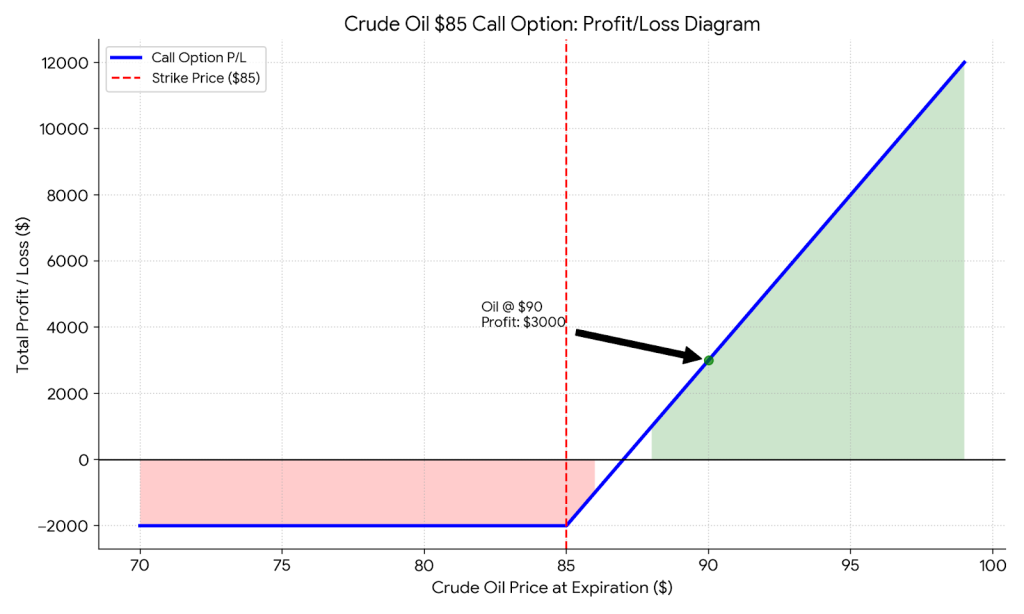
- Crude oil price: $80
- Buy $85 call for $2
If oil rises to $90:
- Intrinsic value = $5
- Profit = $500 per contract (minus cost)
Small investment → amplified return.
Breakdown of the $85 Call Option
The graph below assumes a standard Crude Oil (CL) contract, which controls 1,000 barrels.
- Maximum Risk: The $2 premium you paid per barrel. For one contract, the fixed cost is $2,000. If oil stays below $85, you only lose this initial investment.
- Breakeven Point: Oil must reach $87 ($85 strike + $2 premium) for you to start seeing actual net profit.
- The “Sniper” Scenario: As shown on the graph, if oil hits $90, your contract is worth $5,000 in intrinsic value. After subtracting the $2,000 premium, your net profit is $3,000.
7. Risk Management: The True Profit Driver
Profit in options doesn’t come from winning trades alone—it comes from controlled losses.
Key Principles:
- Risk only 2–5% per trade
- Always define exit points
- Avoid over-leverage
- Use spreads to reduce risk
- Trade with a plan, not emotion
8. The Greeks: Mathematical Control
Options are driven by mathematical sensitivities:
- Delta: Price sensitivity
- Theta: Time decay
- Vega: Volatility sensitivity
- Gamma: Acceleration of delta
Understanding these allows traders to:
- Manage exposure
- Adjust positions
- Hedge effectively
9. Commodity Markets and Global Influence
Commodities do not trade in a vacuum; they are “macro” assets driven by global forces.
- Inflation: Commodities often act as a hedge; for instance, rising inflation frequently leads to higher gold prices.
- Interest Rates: Changes in rates affect the cost of carry and currency valuations, which in turn impact commodity demand.
- Geopolitics & Supply: Conflict or instability in resource-rich regions can cause “Crude spikes” due to potential oil shortages or supply disruptions.
- Currency Strength: Since most commodities are priced in USD, a stronger dollar typically makes them more expensive for international buyers, potentially reducing demand.
Example:
- Rising inflation → Gold increases
- Oil shortages → Crude spikes
10. Profitability Framework: From Analysis to Execution
This structured framework is designed to move a trader from subjective “guessing” to a repeatable, mechanical system. By following these steps in order, you ensure that every trade is backed by data rather than emotion.
- Market Analysis (Trend, Volume, Macro): Before examining specific setups, you must understand the broader market environment.
- Trend: Is the market making higher highs or lower lows? Professional analysis often focuses on how structure and volatility shape price behavior.
- Volume: This measures the conviction behind a move. Traders use order flow and delta volume shifts to see where institutions are active.
- Macro: You must account for global influences such as inflation, interest rates, and geopolitics (e.g., crude oil price spikes during supply disruptions).
- Bias Identification (Bullish/Bearish/Neutral): Once the analysis is complete, you form a directional bias.
- Bullish: Expecting prices to rise.
- Bearish: Expecting prices to fall.
- Neutral: Expecting the market to stay within a range (common for certain option strategies like Iron Condors).
- Strategy Selection: Different market conditions require different “tools”. For example, a “Super Scalper” approach might be used to capture short-term momentum, whereas a “Married Put” or “Bear Call Spread” might be chosen based on technical analysis of specific assets like Gold or the S&P 500.
- Volatility Assessment: Volatility determines the “price” of options. Ignoring volatility is a common mistake that can lead to poor trade outcomes.
- High Volatility: Options are expensive; traders might look to sell premium.
- Low Volatility: Options are cheaper; traders might look to buy calls or puts.
- Strike & Expiry Selection: This is the “where” and “when” of the trade.
- Strike Price: Choosing a price target (e.g., a $85 call for $80 oil).
- Expiry: Choosing how much time you need for the move. Poor strike selection is a primary reason for failure in commodity trading.
- Position Sizing: This is arguably the most important part of risk management. It involves calculating exactly how many contracts to buy so that a single loss does not blow up your account.
- Entry & Exit Rules: Discipline is built on execution, not excitement.
- Entry: Waiting for a “Sniper Entry” at a critical psychological or technical junction.
- Exit: Having a pre-set plan for both profit-taking and cutting losses. Holding losing trades too long is a frequent error.
- Performance Review: The framework concludes with an honest assessment of the trade. This involves reviewing institutional behavior and reaction zones to determine whether the analysis held true, thereby transforming the experience into a repeatable system for future trades. This transforms trading into a repeatable system.
11. Psychological Edge: The Hidden Advantage
Strategy is only half the battle; the “Hidden Advantage” lies in the trader’s internal discipline.
- Patience → The ability to wait for high-probability setups rather than chasing the market.
- Discipline → Strictly following the pre-defined rules of your trading plan.
- Emotional Control → Avoiding impulsive trades driven by fear or greed.
- Consistency→ Recognizing that profit is built on execution and the repeatable application of a plan, not on excitement.
12. Common Mistakes in Commodity Option Trading
- Ignoring volatility
- Overtrading
- Poor strike selection
- Holding losing trades too long
- Lack of risk management
13. From Knowledge to Profit
Commodity option trading is not about guessing price direction.
It’s about:
- Understanding market structure
- Using leverage responsibly
- Managing risk precisely
- Executing consistently
14. The Role of Technology and Modern Tools
Today’s traders don’t operate blindly.
They use:
- Algorithmic insights
- Volume & order flow
- Volatility models
- Structure-based frameworks
These tools help identify:
- Reaction zones
- Momentum traps
- Institutional behavior
Watch the Strategy in Action
For a deep dive into how to use these modern tools to find “hidden gems” and project market trends, check out this breakdown on the OnePunch Algo YouTube channel:
Real Market Example: Analysis of SPY & QQQ
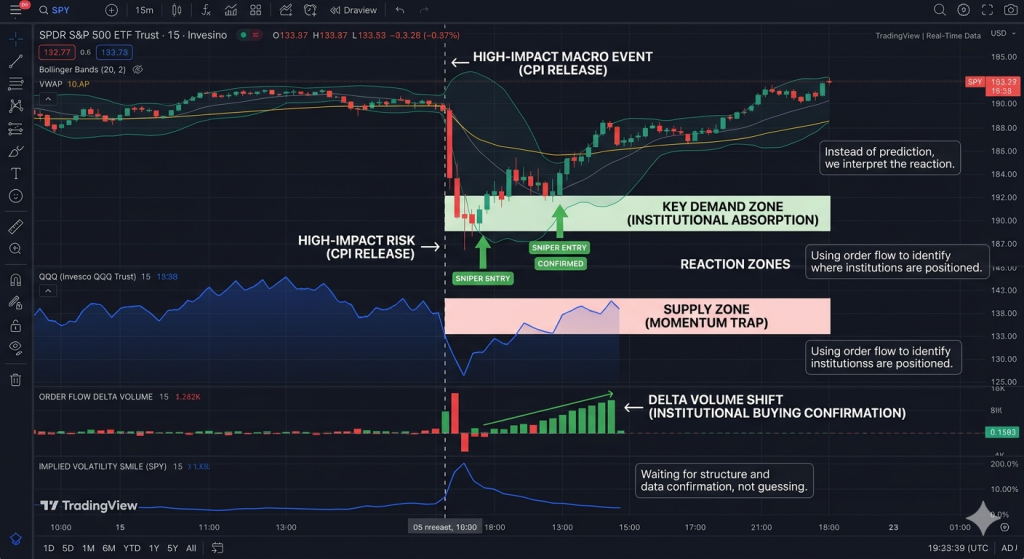
In a high-impact macro event, such as a major inflation data release, a professional analysis does not “predict” the price; instead, it interprets the reaction.
The TradingView Perspective
Imagine a TradingView chart where the following layers are applied:
- Structure-Based Framework: Marking a “Reaction Zone” at a previous psychological bottom (e.g., the 5115.1 level for Gold or a key Fibonacci retracement on SPY).
- Order Flow & Delta Volume: Observing a “Delta Volume Shift” where aggressive buying enters the tape despite a price drop, indicating institutional “absorption”.
- Volatility Assessment: Using an indicator like Bollinger Bands or an ATR-based “Super Scalper” to identify when the move has reached an exhausted state.
Execution: Rather than guessing if the news is “good” or “bad,” the trader waits for the price to hit the reaction zone and looks for a “Sniper Entry” confirmed by order flow. This disciplined interpretation transforms a fast-moving, chaotic event into an informed decision-making process.
Disclaimer: The information, charts, and analysis provided are for educational and informational purposes only and do not constitute financial, investment, or trading advice. Market analysis is designed to demonstrate technical frameworks and institutional behavior, not to serve as a direct recommendation to buy or sell any security.
Conclusion: Engineering Profit in Commodity Markets
Commodity option trading represents one of the most advanced forms of market participation. It blends real-world economic forces with financial engineering, allowing traders to design outcomes rather than react to them.
When approached with discipline, knowledge, and structure, options transform uncertainty into opportunity.
It gives traders the ability to:
- Control risk
- Leverage capital efficiently
- Profit in any market condition
- Adapt to volatility
But mastery doesn’t come from knowledge alone; it comes from application, refinement, and structured learning.
As traders deepen their understanding, they often seek environments that support growth through real-market exposure, strategy development, and consistent practice.
That’s where ecosystems like OnePunch ALGO Academy (a dedicated trading platform and community) and the OnePunch ALGO YouTube Channel naturally fit into a trader’s journey. They provide structured systems, market breakdowns, and practical insights that help bridge the gap between theory and execution, supporting traders as they refine discipline, sharpen decision-making, and evolve their strategies over time.
To complement this, the OnePunch ALGO YouTube Channel serves as a powerful learning companion, delivering strategy walkthroughs, market analyses, and educational breakdowns designed to strengthen a trader’s understanding of options.Commodity option trading is not about chasing price.
It’s about designing outcomes, controlling risk, and executing with precision.